You take your reading glasses off to rub your eyes, set them down to answer the door, and ten minutes later you are squinting at the room trying to find a thin, clear object without the thing that helps you see thin, clear objects. Where to keep glasses is less about one perfect spot and more about making sure there is always a pair, and a case, where you actually use them.
Room-by-room plan
| Room | What to keep there | Tip |
|---|---|---|
| Bedside | Your main glasses overnight, in an open case or a small tray | An open case means you put them in without thinking; a closed case gets skipped. |
| Living room | A cheap pair of readers by your chair | Keep them on the side table, not the arm of the sofa, where they slide into the cushions. |
| Kitchen | Readers for recipes and packet labels | A hook or a small dish away from the sink and stove. |
| Desk or home office | Computer or reading glasses | A stand or case at the back of the desk, not on top of papers. |
| Car | Sunglasses and, if you need them, a spare pair for driving | Use a hard case in the door pocket or console; a hot dashboard can damage lenses and frames. |
| Bag or coat | A slim case for whatever pair you are wearing | So the glasses have somewhere to go besides a pocket full of keys. |
The "readers everywhere" approach
If you use non-prescription reading glasses, the simplest fix is to own several identical cheap pairs and leave one wherever you read. Same strength, same frame, so it never matters which one you pick up. If your prescription is different in each eye or you need progressives, this does not work as well; speak to your optician about whether a second, simpler pair is worth having for around the house.
Habits that keep glasses findable
- Case or face, nothing else. Glasses are either on you or in a case. Not on the counter, not folded into a book.
- Watch the head habit. Pushing glasses up onto your head is the classic way to "lose" them while wearing them. If you do it, at least check there first.
- Use a cord or chain if you take reading glasses on and off all day. Not glamorous, very effective.
- Bright cases. A red or yellow case is easy to spot from across a room; a black one disappears on a dark shelf.
Spare pairs and old prescriptions
A spare pair is the best insurance against a broken arm or a lost pair before a trip. Many people keep their previous pair after a new prescription. If you do, decide on one place for it, ideally a labeled case in a drawer with your other backup things, and do not let it wander into the car or a coat.
Old prescriptions pile up. Keep the most recent one or two as backups, and consider donating the rest; many opticians and charities collect used glasses. Throwing them into the junk drawer is how you end up with six identical cases and no idea which pair is which. If you keep more than one, label the case with the year.
Keep a copy of your written prescription too. A photo on your phone works, and so does a note in the same drawer as the spare pair.
Where lost glasses usually are
- On your head, or hooked into your shirt collar.
- Between or under sofa and chair cushions.
- In the bathroom, by the sink, on the windowsill or by the tub.
- Next to the last thing you read: the mail pile, the recipe book, the bed.
- In the car: door pocket, sun visor, under the seats.
- In a coat pocket or the bag you used last.
- In the fridge, if you took them off while putting shopping away. It happens.
A tip from many glasses-wearers: if you have a second pair, put it on before you search. Looking for clear lenses on a pale surface is much easier when you can see.
Where Jot the Spot fits
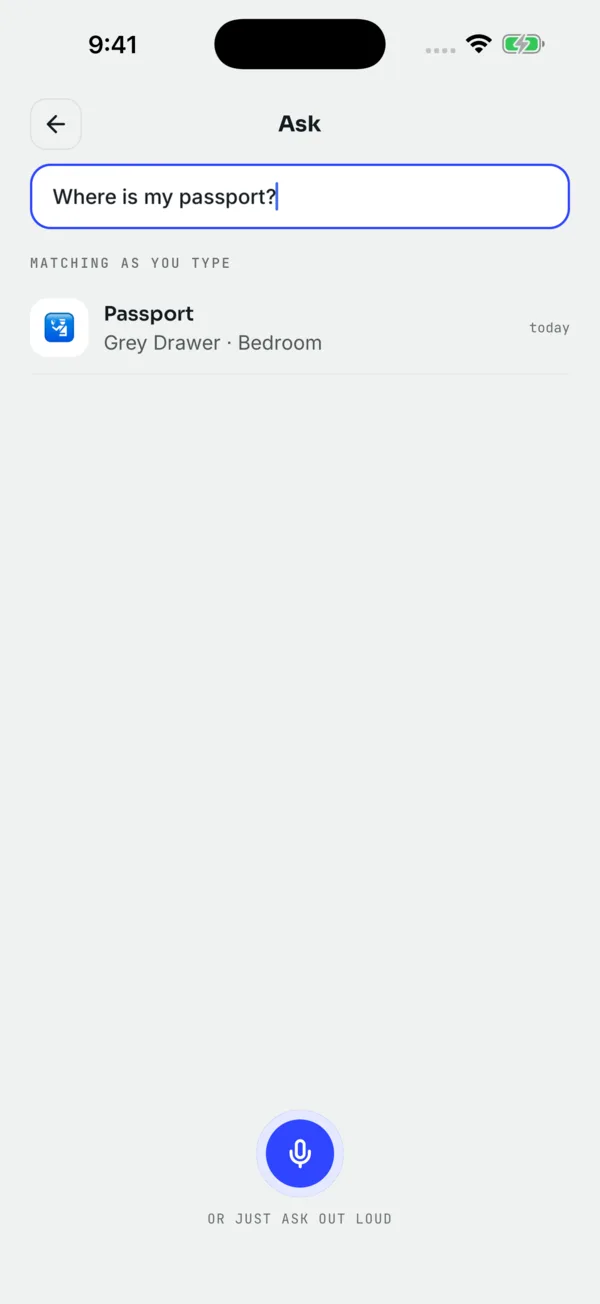
For the pair you wear every day, a note app is overkill; the habits above do the work. Where it earns its place is the glasses you rarely touch: the spare pair, the prescription sunglasses packed away for winter, the old pair you keep for emergencies, the backup contacts. Tap the mic and say: "Spare glasses, brown case, second drawer of the bedroom dresser." Or "Prescription sunglasses, in the ski bag, top shelf of the hall closet." In June you ask "where are my prescription sunglasses?" and get the answer. Search is forgiving, so "sunnies" or a near-miss spelling still matches. If you have trouble with the screen, answers can be read out loud with Unlimited.
It will not find a pair you never jotted, and it cannot tell you which cushion they slid under. For people who misplace things all day, our page on object permanence and ADHD has broader habits, and families helping ageing parents may find a shared list of spares useful through household sharing.
Questions people ask
Is it bad to keep sunglasses in the car?
Heat can warp some frames and damage lens coatings, so keep them in a hard case out of direct sun, such as the door pocket or console, rather than on the dashboard.
Should I keep my old glasses?
Keeping your most recent previous pair as a spare is useful if your current pair breaks. Older pairs can often be donated through opticians or charities.
How do I stop losing my reading glasses?
Keep a cheap identical pair wherever you read, use bright cases, and follow the rule that glasses are either on your face or in a case.
 Download on the App Store