Why storage units are so hard to search
At home, you pass your closets every day. A storage unit you might visit three times a year, often in a hurry, and the boxes are stacked floor to ceiling and several rows deep. You remember packing the winter coats. You do not remember whether they went in at the start (back left, under the books) or at the end (front, easy to reach). So you unload half the unit onto the corridor floor to find out.
The fix is to decide where things go while you load, and to write it down in a way you will have with you when you are standing at the roller door.
Making a box map, step by step
- Number every box. Use a thick marker and write the number on two sides and the top. Numbers are faster to read across a dim unit than descriptions. Our storage box labeling guide has more on what to write and where.
- Split the unit into zones. For most units, six zones are enough: back left, back middle, back right, front left, front middle, front right. If your unit is tall, add "high" and "low."
- Load in order of how often you will need things. Rarely needed items (archived papers, sentimental boxes, spare furniture) go at the back. Seasonal items go in the middle. Anything you might want on the next visit goes at the front.
- Leave an aisle. Even a narrow walkway down one side means you can reach the back without unloading the front. It costs a little space and saves a lot of lifting.
- Record each box as it goes in. The box number, a short list of what is inside, and its zone: "Box 14, winter coats and boots, back right, top of the stack."
- Take a photo of each wall when you are done. A photo of the stack shows you the shape of the unit, which is hard to remember after six months.
An example box map
| Zone | Boxes | What is there |
|---|---|---|
| Back left | 1–6 | Archived papers, old tax files, sentimental boxes |
| Back right | 7–14 | Winter coats and boots (14), spare bedding, ski gear |
| Middle | 15–22 | Kitchen overflow, books, holiday decorations (19–20) |
| Front left | Not boxed | Dining chairs, rolled rug, bike |
| Front right | 23–26 | Camping gear, things you might need next visit |
The map does not have to be perfect. It has to be good enough that you walk straight to the right corner.
What to pack where
A few things to think about before they go into storage:
- Important documents are usually better kept at home, where you can reach them quickly. If papers do go into storage, keep a note of which box. See where to keep birth certificates and documents.
- Anything with a date (food, batteries, medicines, paint) needs checking. Many facilities have rules on what can be stored, so read your agreement.
- Clothes and bedding keep better in sealed plastic tubs than cardboard, especially in units that are not climate controlled.
- Furniture parts such as screws, legs and shelf pins should be bagged and taped to the piece they belong to.
Unit details: what to note and what not to
Keep a note of the facility name, unit number, the floor or row, opening hours, and which lock you used. Those are the things people forget between visits.
Do not jot gate codes or PINs in Jot the Spot or any notes app. Keep the access code in a password manager, and keep the key for the padlock somewhere you have recorded at home.
Using Jot the Spot for a storage unit
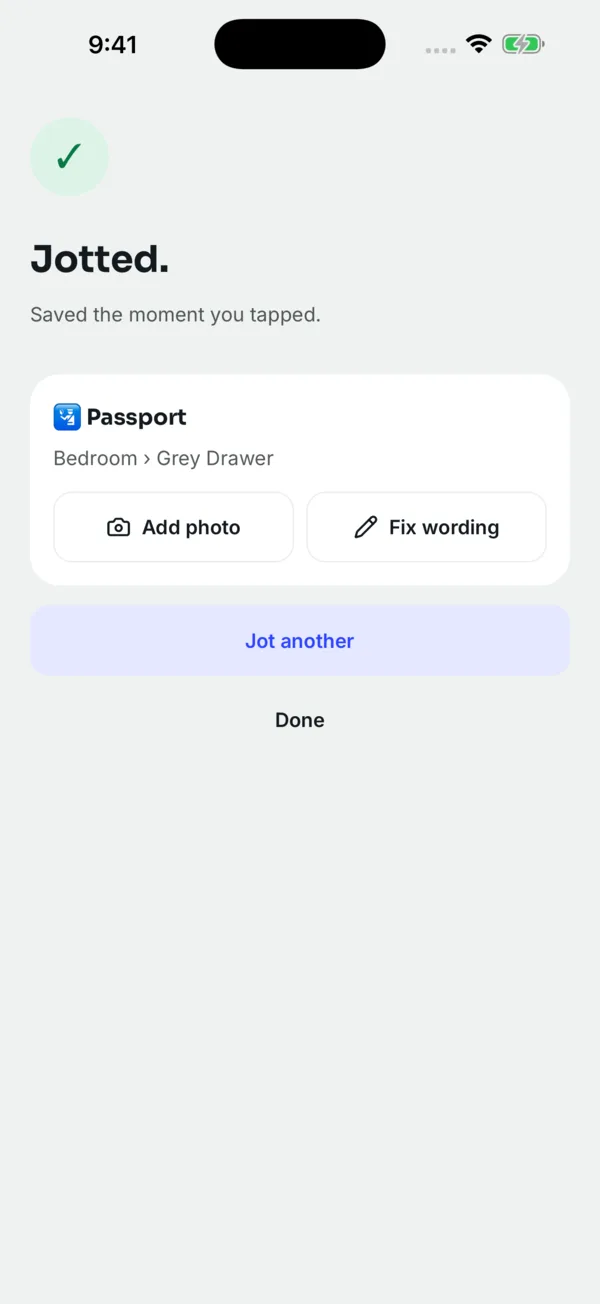
Jot the Spot was made for this kind of memory: something put away once, needed months later. As each box goes in, tap the mic and say it: "Winter coats and boots, box 14, back right, storage unit." "Christmas lights, box 19, middle, storage unit." At home in November, ask "where are the winter coats?" and you get box 14, back right, before you get in the car.
You can ask by place as well. "What's in the storage unit" lists everything you have jotted there, which is useful for deciding whether you still need the unit at all.
For tall, tightly stacked units, a photo of the spot (on Unlimited) is worth a lot: you see exactly which stack and how high. The app works offline, so a facility with no signal is not a problem; see offline and private.
The honest limit: the map is only as good as your jots. If you move boxes around on a visit and do not say so, the app points at where they used to be. A quick "moved box 14 to the front" as you leave keeps it accurate.
Questions people ask
How should I organize a storage unit?
Number every box, divide the unit into zones, load rarely needed items at the back and likely needs at the front, and leave a walkway so you can reach the back.
How do I remember what is in each storage box?
Write a box number on several sides, then keep a list of what is in each numbered box and which zone it is in. A photo of each stacked wall helps too.
Is it safe to store my storage unit gate code in a notes app?
It is better to keep access codes in a password manager. Do not save them in Jot the Spot or a general notes app.
Does Jot the Spot work in a storage facility with no signal?
Yes. Your jots live on your phone and asking searches that copy, so it works without a connection. Jots made offline sync later.
 Download on the App Store