Most people label storage boxes the way they pack them: in a hurry, with whatever marker is nearby, and with a word like "kitchen" or "stuff" that made sense at the time. A year later the box is in the garage, the label faces the wall, and you have no idea which of the six "kitchen" boxes has the waffle iron.
A storage box labeling system fixes that with four parts: a number, labels on two sides, a color code, and a master list. The first three take minutes. The fourth is where most systems fail, and there is a simpler way to keep it current.
1. Number every box
The number is the most important part of the label. Contents change; the number does not. Start at 1 and never reuse a number, even after a box is emptied and recycled. That way "box 14" always means one box, and any note you made about it stays valid.
- Write the number big, at least two inches tall, in thick black marker.
- If you have several storage areas, add a letter: G for garage, A for attic, U for a storage unit. "G-14" tells you where to go before you start looking.
- Pre-printed number stickers are cheap and neater than handwriting, but a marker works fine.
2. Label two sides, not the lid
Lids get stacked on, removed and swapped between boxes. Put the label on one long side and one short side, so whichever way the box sits on a shelf, a label faces you. Each label should carry:
- The box number.
- The room or area it belongs to (or came from, if you are moving).
- A short, specific contents line. "Kids' summer clothes, sizes 4–6" beats "clothes". "Camping stove, gas, lantern" beats "camping".
Use a label you can change. Masking tape or a removable label means you can update the contents line when you swap things in and out, instead of crossing out and squeezing new words into the margin.
3. Add a color code (optional but handy)
Colored tape or stickers let you spot a category from across the room. Keep it to five or six colors, or it stops helping. One common scheme:
| Color | Category |
|---|---|
| Red | Holidays and seasonal decorations |
| Blue | Clothes and bedding |
| Green | Outdoor, camping and sports |
| Yellow | Kitchen and entertaining |
| Purple | Keepsakes and sentimental |
| White | Paperwork (better kept indoors) |
When moving house, many people color code by destination room instead, so movers can drop boxes in the right place. Our moving house use case covers that version.
4. Keep a master list
The master list connects numbers to contents and locations. Box 14: garage, top shelf, left. Contents: waffle iron, fondue set, party glasses. Without it you are back to opening boxes. The question is how to keep it.
Why the perfect spreadsheet goes stale
The classic advice is a detailed spreadsheet: one row per box, every item listed, maybe photos. It is satisfying to build and almost nobody keeps it up. The reasons are predictable:
- You change a box in the garage, and the spreadsheet is on a laptop in the house.
- You take one thing out "just for the weekend" and do not update the row.
- Listing every item is so much work that you stop after box 9.
- Someone else in the house moves a box and never sees the list.
A list that is 80 percent right feels reliable until the day it sends you to the wrong shelf. After that, nobody trusts it.
A spoken list that keeps up
The fix is making updates so quick you do them standing next to the box. A numbered box plus one spoken sentence is enough. With Jot the Spot, you tap the mic and say "Box 12, kids' summer clothes 4–6, garage top shelf." When you move it, say it again: "Box 12, now in the attic, left of the hatch." Asking "where's box 12?" gives you the newest spot, and the history of earlier spots is kept.
You can also ask by place: "What's on the garage top shelf?" lists everything you jotted there. If you mostly look for contents rather than numbers, lead with them instead: "Kids' summer clothes 4–6, box 12, garage top shelf." Search is forgiving about close spellings, and you can type instead of talking if the garage is noisy. For boxes that are hard to describe, Unlimited adds a photo of the spot.
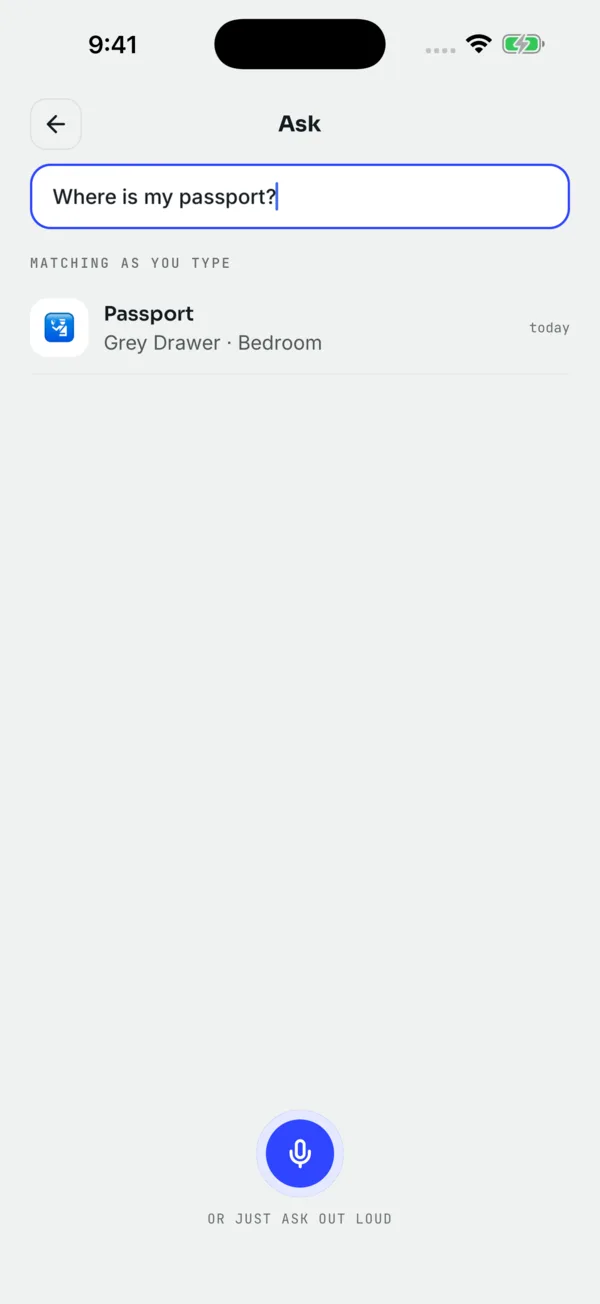
Two honest limits. It is a personal and household tool, not warehouse software: no barcodes or stock counts. And it only knows what you say. If you skip the jot when a box moves, the answer is one move behind. If you run a stockroom rather than a home, see the small business stockroom page for where it fits and where it does not.
Labeling mistakes to avoid
- "Misc" or "stuff". If you cannot name it, sort it before you box it.
- Label only on the lid. Stacked boxes hide lids.
- Reusing numbers. Old notes then point to the wrong box.
- Overpacking. A box too heavy to lift down does not get opened, so its label stops mattering.
- Paperwork in garage boxes. Damp and heat ruin it. Important papers belong indoors; see where to keep important documents.
Questions people ask
What is the best way to label storage boxes?
Give every box a unique number, put labels with the number, room and specific contents on two sides rather than the lid, and keep a master list linking numbers to locations.
Should I list every item in every box?
Usually not. List the things you are likely to look for and keep the line short. A detailed list that goes out of date is less useful than a short one you keep current.
What labels work best on plastic storage bins?
Removable labels or masking tape with a thick marker work well because you can change them. Some plastics resist marker, so test first.
How do I keep track of which box is where?
Note the box number and its location every time it moves, at the moment you move it. A quick voice note is the easiest way to keep that habit.
 Download on the App Store