"Mum, where's the tape?" "Dad, have you seen my football boots?" "Where did you put the passports?" In most homes there is one person who is expected to know where everything is, and it is exhausting. They are not more organized than everyone else; they just happen to be the one who put most things away. When they are at work or away, the house stops being able to find anything.
This page is about sharing that job: a handful of family house rules for shared things, how to get kids and partners to stick to them, and how one shared memory for where things are can help. If you want the details of how sharing works inside the app, the household sharing page covers the mechanics. This one is about family life.
Why one person ends up as the family's memory
- They put things away. Whoever tidies decides where things go, and that knowledge lives only in their head.
- Everyone else asks instead of looking. Asking is quicker than searching, so the habit reinforces itself.
- Homes for things are unspoken. The batteries live in the kitchen drawer because one person decided that years ago. Nobody else was told.
The fix is not to make everyone tidier. It is to make where things live visible to everyone.
Six house rules for shared things
- Agree homes for the shared stuff, out loud. Sit down for fifteen minutes and agree where the top shared things live: scissors, tape, batteries, the first aid kit, spare keys, the good charger, the passport folder, the remote. Write the list down and stick it inside a cupboard door.
- "Jot it when you move it." If you take something out of its home and leave it somewhere else, you say so. In a notebook, on the fridge, or in a shared app. This one rule removes most "who moved it?" arguments.
- Personal things get personal homes. Each child gets one hook, one shelf and one box for their own stuff. Lost items found around the house go there.
- Look before you ask. Kids check the agreed home, and the list, before shouting for a parent.
- Sunday sweep. Five minutes, everyone puts back three things that are not in their home.
- Things that live outside the house get written down. The camping gear at Grandad's, the cot in the neighbor's garage, the bikes at the storage unit. These are the most forgotten of all.
For the kids' own stuff, including school uniform, sports kit and toys, see our page on keeping track of kids' stuff. For the drawer where everything without a home ends up, there is a guide to the junk drawer.
One shared memory: what it looks like in a family
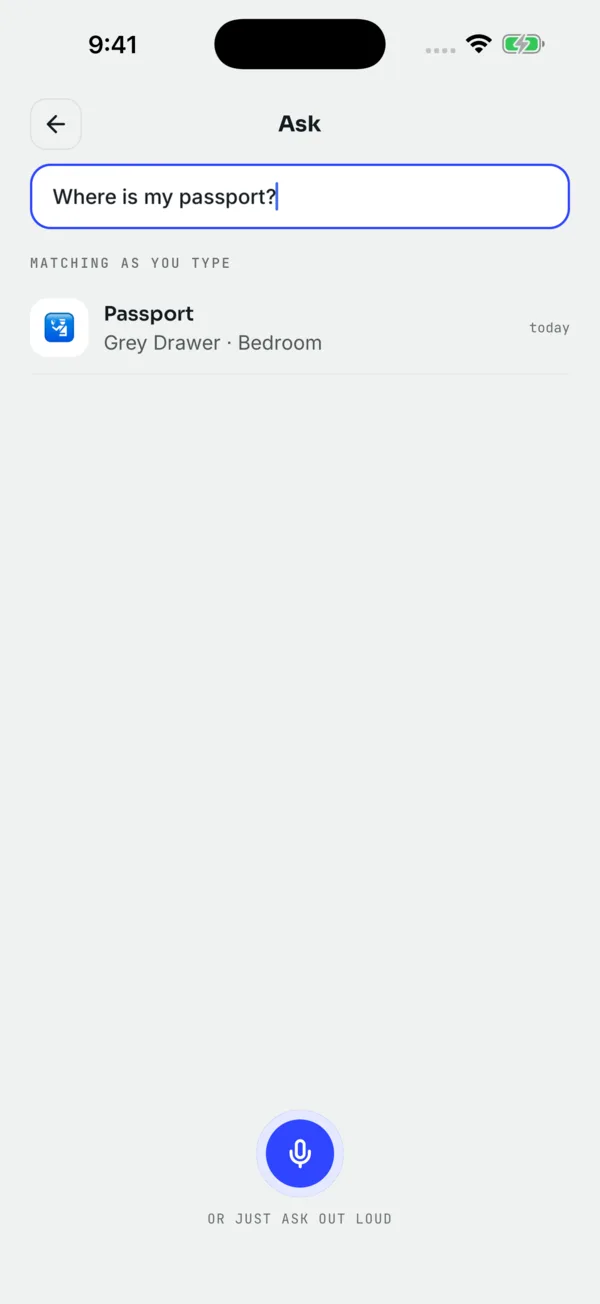
Jot the Spot is a voice memory for where things are. With household sharing (part of the Unlimited plan), the family shares one memory. What any of you jots, all of you can ask.
A week in a family that uses it might look like this:
- Monday: a parent puts the birthday present for a cousin away. "Present for Sam, wrapped, top of the wardrobe in our room."
- Tuesday: your teenager borrows the good charger. "Fast charger, my room, on the desk." That is rule two, done by voice.
- Wednesday: a partner moves the spare car key while cleaning out the hall. "Spare car key, now in the key safe in the garage."
- Saturday: the younger one asks the app, "where are my football boots?" and gets "Boots, boot room shelf, bottom" instead of shouting up the stairs.
Each thing keeps a history of every spot it has been in, and who jotted each one. So when the scissors are not where the app says, you can see who last moved them and ask them, rather than the whole house.
Kids, partners and roommates
Kids old enough to have their own phone can join; younger ones can ask out loud on a parent's phone. Partners usually take to it fastest, because it ends the "where did you put…" texts. The same setup works for roommates and house shares: shared things in one memory, and anyone can leave at any time and take their own jots with them.
What sharing can't fix
The app only knows what someone told it. If a family member moves the passports without jotting it, the answer will be out of date until someone does. That is why the "jot it when you move it" rule matters more than the tool. Sharing is also part of Unlimited ($2.99 a month or $19.99 a year); the free plan covers up to 10 things on your own phone, without sharing. See pricing.
Questions people ask
How do I stop my family asking me where everything is?
Agree homes for shared things together, write the list down, and make a rule that anyone who moves something says where it went. Then point people to the list instead of answering.
Can my whole family use one Jot the Spot list?
Yes. With household sharing on Unlimited, you invite family members by link or code, and anyone in the household can jot and ask.
Can I see who moved something last?
Yes. Each thing keeps its full history of spots and who jotted each one.
What age can kids use it?
Any child who can talk can ask on a parent's phone. Kids with their own phone can join the shared household and jot their own things.
 Download on the App Store