Where to keep warranties and receipts matters exactly once per appliance: the day it stops working. Until then the paperwork just has to exist, be readable, and be somewhere you can find in five minutes. Most people fail on the last part. The receipt went in a kitchen drawer, the manual went in a box in the attic, and the warranty card is in the original packaging that went to recycling. Here is a setup that takes about ten minutes per purchase and holds up for years.
Step 1: Pick one home for all of it
Choose a single container and use it for every warranty, guarantee and receipt worth keeping. Options that work:
- An accordion (expanding) file. Cheap, portable, with tabs for kitchen, electronics, furniture, tools, car. Good for most households.
- A ring binder with clear sleeves. Easy to flick through, and the sleeves hold small receipts and manuals together. Gets bulky after a few years.
- A labeled envelope per item inside any of the above. Receipt, warranty card, serial number and model number all in one envelope with the product name written on the front.
Keep it somewhere dry and indoors: an office shelf, a desk drawer, a closet shelf. Not the attic/loft, the garage or under the kitchen sink. If you already have a place for birth certificates and important documents, put the warranty file next to it, but keep them separate. You will open the warranty file far more often.
Step 2: Photograph every receipt the day you get it
Many shop receipts are printed on thermal paper, the shiny kind that fades with heat, light and time. A receipt left in a sunny car or a warm drawer can be blank within a year or two. Take a clear photo or scan as soon as you get home, and keep the paper too, since some sellers prefer the original.
For online orders, save the confirmation email to a dedicated folder in your inbox called something like “Receipts and warranties.”
Step 3: Write down what the shop will ask for
When something breaks, the manufacturer or retailer will usually ask for some mix of these. Note them on the envelope or a sticky note on the receipt:
- Product name and model number
- Serial number (often on a sticker on the back, the base, or inside the door)
- Purchase date and where you bought it
- Price paid
- Warranty length, and whether you registered it with the manufacturer
- Any extended warranty or protection plan, with its own reference number
Photograph the serial number sticker too. On a washing machine it is easy to read on day one and very hard to reach once the machine is pushed under the counter.
Step 4: Keep the manual with the receipt, or not at all
Paper manuals are bulky and most are available online from the manufacturer. A reasonable rule: keep the manual only if it covers something you will need offline, like a boiler reset sequence, and file it in the same envelope as the receipt. Otherwise, note the model number and recycle the booklet.
Step 5: Note when the cover ends
This is the step almost everyone skips. A warranty is only useful if you know it is still running. Work out the end date when you file it and write it on the front of the envelope, large: “Warranty ends March 2028.” Once a year, clear out paperwork for things you no longer own.
Before you throw anything out, check whether you need it for anything else, such as a tax claim, an insurance claim or a return. If in doubt, ask whoever does your taxes, or keep it a little longer.
Mistakes that cost people the claim
- Keeping the receipt in the product box. Boxes get flattened and recycled.
- Relying on a faded thermal receipt. Photograph it first.
- Splitting the paperwork. Receipt in one drawer, warranty card in another, serial number on a machine you cannot pull out.
- Not knowing the end date. People pay for repairs that were covered, or chase claims that expired months ago.
- Two folders in two houses. After a move, half the paperwork is in a box marked “office misc.” The guide to keeping important papers safe when moving covers this.
When the receipt is already missing
Search your email for the store name and the product. Check the store account or app for order history. Look at your bank or card statement for the date and amount, which some retailers accept as proof of purchase. If you registered the product with the manufacturer, they may already have the purchase date on file. And check the obvious paper traps: the kitchen junk drawer, the glovebox, last year’s tax folder.
How a jot covers the gap
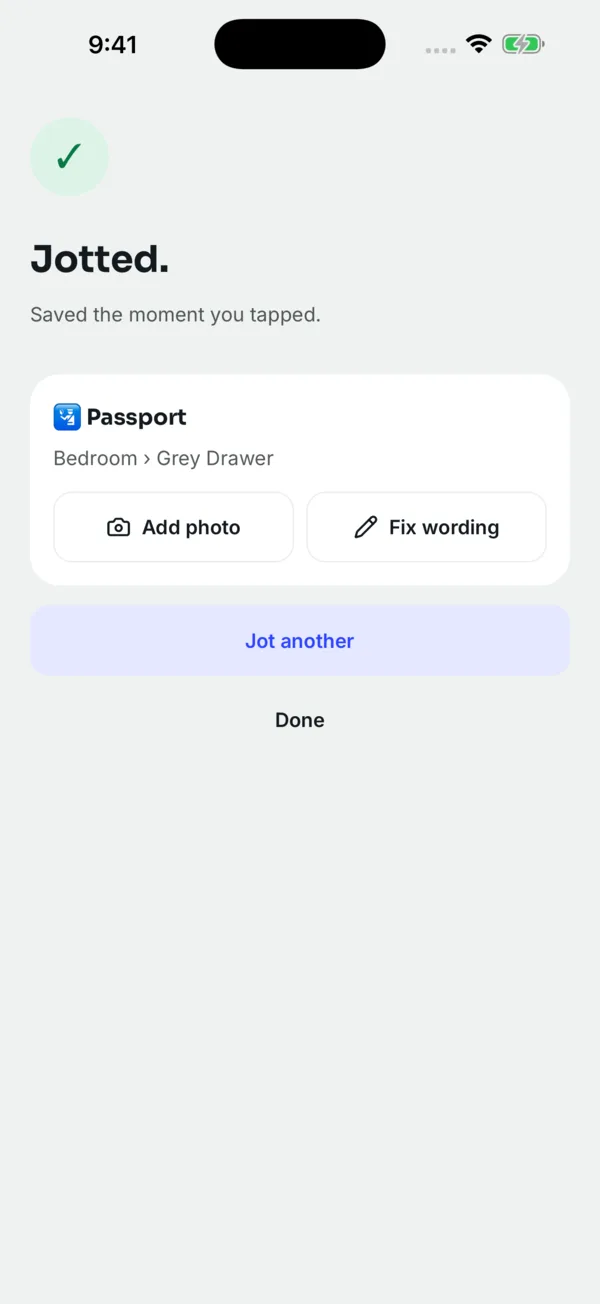
The folder solves storage. It does not solve “which folder?” or “is it still under warranty?” That is where a quick voice note helps. When you file the paperwork, say one sentence into Jot the Spot:
“Dishwasher warranty, blue folder, office shelf, expires in 11 months.”
Months later, ask “where’s the dishwasher warranty?” and you get the folder and shelf back, with the date marked Due soon as it gets close. With expiry reminders allowed, your phone sends a notification before the cover ends, which is the moment to get that strange noise looked at. For big items, a photo of the spot can hold the serial sticker too.
The limit is simple: it only knows what you tell it. If the receipt moves to a different drawer and nobody jots it again, the app still points at the blue folder. It also is not a document scanner or a receipt store, so keep the photo of the receipt in your phone’s photo library or a folder you trust.
Questions people ask
How long should I keep receipts for appliances?
At least as long as the warranty runs, and longer if you might need them for insurance or tax. Many people keep them for as long as they own the item.
Do thermal receipts really fade?
Yes. The shiny paper many shops use fades with heat and light, sometimes within a year or two. Photograph or scan it the day you get it.
What if I lost the receipt but need to make a warranty claim?
Try order history in your store account, the confirmation email, or a bank statement showing the purchase. Some manufacturers also accept product registration as proof.
Can Jot the Spot store my receipts?
No. It remembers where you put the paperwork and when the cover ends if you say the date. Keep the receipt photo in your photo library or a folder you trust.
 Download on the App Store